

Since the dawn of history, various cultures have commemorated mythical figures in the grandest way they could – colossal statues. These statues served as centers of worship and social symbols. For many generations, artists and sculptors compiled pagan religions and produced sublime and dramatic myths that influenced the culture of believers.
This situation changed with the emergence of the three monotheistic religions – Judaism, Christianity, and Islam. These religions, which replaced many gods with one, almighty God, also changed the approach to art in a certain way. In ancient times, as mentioned, statues were created mainly for worship, and not only statues, but also paintings, stories, and poetry.

In the Ten Commandments, the creation of statues and images was forbidden, as they are an expression of idol worship. Likewise, the worship of God through statues and images was forbidden, referring to any physical body form: "You shall not make for yourself a carved image or any likeness of anything that is in heaven above, or that is in the earth beneath, or that is in the water under the earth" (Exodus 20:4).
In some places, a statue is mentioned alongside a mask, a monument, an ephod, and teraphim, or the name of the god the statue symbolizes is given to it. Because of this prohibition, Jews, and also Muslims, refrained from sculpting and painting figures even for artistic purposes.
Statues and Sculpture in History
The first statues were created about 10,000 years ago, in Egypt and Greece. Many centuries later, the influence of sculpture also reached the Roman Empire, which often copied Greek bronze statues in marble.
In the Middle Ages, from the 4th century onwards, the transition of Byzantine culture and art led to a major change in the role of sculpture. The church becoming the main patron of artworks subjected the art of sculpture to religious and messianic themes and to the decoration of Christian cathedrals.
In the modern era, art relatively broke away from religious dogma during the Renaissance, and the nature of sculpture became naturalistic and classical, often depicting nudity, for example. Leonardo da Vinci expressed that it is an intellectual act of revealing the beauty in nature and making it visible in a work of art.

This situation changed with the emergence of the three monotheistic religions – Judaism, Christianity, and Islam. These religions, which replaced many gods with one, almighty God, also changed the approach to art in a certain way. In ancient times, as mentioned, statues were created mainly for worship, and not only statues, but also paintings, stories, and poetry.
In the Ten Commandments, the creation of statues and images was forbidden, as they are an expression of idol worship. Likewise, the worship of God through statues and images was forbidden, referring to any physical body form: "You shall not make for yourself a carved image or any likeness of anything that is in heaven above, or that is in the earth beneath, or that is in the water under the earth" (Exodus 20:4).
In some places, a statue is mentioned alongside a mask, a monument, an ephod, and teraphim, or the name of the god the statue symbolizes is given to it. Because of this prohibition, Jews, and also Muslims, refrained from sculpting and painting figures even for artistic purposes.
Statues and Sculpture in History
The first statues were created about 10,000 years ago, in Egypt and Greece. Many centuries later, the influence of sculpture also reached the Roman Empire, which often copied Greek bronze statues in marble.
In the Middle Ages, from the 4th century onwards, the transition of Byzantine culture and art led to a major change in the role of sculpture. The church becoming the main patron of artworks subjected the art of sculpture to religious and messianic themes and to the decoration of Christian cathedrals.
In the modern era, art relatively broke away from religious dogma during the Renaissance, and the nature of sculpture became naturalistic and classical, often depicting nudity, for example. Leonardo da Vinci expressed that it is an intellectual act of revealing the beauty in nature and making it visible in a work of art.
(Pictured: A relief sculpture in honor of Leonardo da Vinci, visited by the Duke of Milan).
The first statues in non-Western cultures were created about 5,500 years ago in India. These statues belong to the Indus Valley Civilization and are now located in Pakistan. Among the remains of this culture, ceramic statues, bronze and clay figurines have been found. With the rise of Hindu and Buddhist cultures, we see large-scale stone-carved sculptures in various temples.
In Japan, the first evidence of sculpture appeared in the 2nd century BC, and mainly includes pottery wrapped in ropes. Buddha figures arrived in Japan through influence from Korea and India. However, until about the 18th century, the Edo period in Japan, during which the country was modernized, the art of sculpture almost disappeared from the religious world.
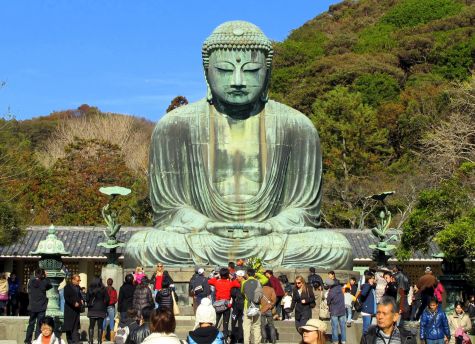
(Pictured: The giant Buddha statue at Kamakura Temple, Japan).
In China, a continuous cultural and artistic tradition can be observed, extending to our time, beginning with burial structures containing cast bronze vessels and animal-shaped pottery in the 9th century BCE. During the Han Dynasty in the 2nd century BCE, sculpture exhibited a naturalistic tendency in the design of figures' details and clothing. The most famous item from this period is the "Terracotta Army" soldiers, found in the tomb of China's first emperor.

(Pictured: The Terracotta Army in China, with over 7,000 figures).
Parallel to the Middle Ages in Europe, this period in China, between the 7th and 10th centuries CE, was considered a "Golden Age" and was characterized by decorativeness influenced by Buddhist art. Rounded figures were replaced by thinner sculpting, and body postures were fully expressed. Portrait depictions were minimized, and unlike Europe, nudity was not present at all.
And what about African sculpture? It's impossible to generalize about African sculpture styles, as each region developed a different artistic tradition, and the development according to the historical timeline is also incomplete. Materially, African sculpture is mostly made of natural materials, primarily wood carving. Usually, a particular body part is emphasized, and this is especially evident in the sculpting of ritual masks, helmets, or wooden hats.
So we've all seen or heard of the world's famous statues, like David's statue in Florence, Ramesses II's statue, the Laocoön statue in Rome, Marcus Aurelius in Rome, the Statue of Liberty in New York, the statue of Christ the Redeemer in Rio de Janeiro, the statue of The Thinker in Paris, the Moai statues on Easter Island, and many more...

(Pictured: David's statue in Florence).
So you might not be able to put one of these statues in your living room or office, but we have some nice sculptures you might want to decorate your home with.
Our Yoga figurines are simply a must-have for all yoga lovers, and even for those who aren't. They represent tranquility and balance, and will add that same atmosphere to your living room, bedroom, office, or studio. They come in various yoga poses: downward-facing dog, chair pose, cobra pose, and more...

Another figurine that can add an African ambiance to your living room is the elephant figurine. You can buy it as a gift for your mother or grandmother who always protects and saves you. The figurine symbolizes motherly love and is a form of gratitude to a mother. In Feng Shui, elephants symbolize strength, protection, wisdom, and good luck, all in a perfect design.

We won't finish without mentioning the sculptures that will suit any room in the house and add a lot of romance, calm, and tranquility. The Light Keeper sculptures, which definitely keep the candlelight you place on them. Each sculpture/candlestick is handmade and made of strong and durable cast iron, making it a great gift for holidays.

Now is the perfect time to decorate your home with some stunning figurines, so what are you waiting for?
2 comments
קניתי פסל יוגה אחד והוא מהמם!
אקנה עוד אחרי שאפתח את הסטודיו :)
אהבתי את פסלוני היוגה, כולם מתלהבים מהם. תודה!